Mandala Name Card Business Card Template
First Impression: Delicate, Centered, and Quietly Confident
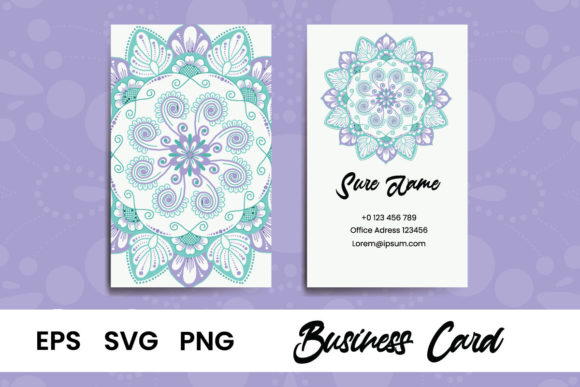
When I opened the Mandala Name Card Business Card Template, my eye didn’t jump—it settled. That’s rare with digital embroidery files. The symmetry feels intentional, not decorative for decoration’s sake. It’s a circular mandala layout built around a central name field, with layered petals, subtle linework, and breathing room between elements. There’s no aggressive density or visual shouting—just balance, rhythm, and quiet reverence for the craft. As someone who’s stitched hundreds of mandalas onto baby onesies, linen tea towels, and boutique aprons, I immediately saw its potential: not as a standalone logo, but as a *signature moment*—a small, meaningful pause in an otherwise busy handmade product.
Where It Lives Best: Thoughtful Embroidery Projects
This isn’t a design for loud branding on a gym bag. It thrives where intention matters: embroidered pillow covers for nursery decor, monogrammed kitchen towels for wedding gifts, custom patches sewn onto denim jackets for Etsy sellers, or delicate sweatshirt embroidery for mindful lifestyle brands. I recently used a similar mandala structure (though less refined) on a cotton-linen blend tote for a local herbalist—and customers kept commenting on how “calm” it felt to hold. The Mandala Name Card Business Card Template would elevate that same feeling: grounded, personal, and quietly professional.
It works especially well for small-batch craft businesses aiming for cohesion—not just across products, but across touchpoints. Imagine stitching it onto a linen cap for your shop team, then using the same vector file for your business card print template (Print Templates category), and even adapting the AI or EPS version for a simple Instagram highlight icon. That kind of asset continuity saves time and strengthens brand recognition without overdesigning.
Real Embroidery Considerations: What Holds Up—and What Needs Care
Let’s be honest: mandalas can turn muddy under the needle if detail isn’t balanced with stitch logic. This design avoids that trap—but only if used thoughtfully. On smooth, medium-weight fabrics like cotton poplin or twill, the satin-stitch petals read cleanly, and the center name field stays legible even at 2.5" diameter. But on textured fabrics—like terry cloth towels or bouclé baby blankets—I’d simplify the outer ring or reduce stitch density manually before loading the embroidery file.
Curved surfaces demand caution. If you’re planning to stitch this on a cap or curved pillow edge, test the hoop size first. A tight 4" hoop may crop delicate outer filigree; a 5" gives breathing room but requires repositioning care. And on stretchy fabric? Always pair with cutaway stabilizer—not tear-away—to prevent puckering in those fine concentric lines.
Dark fabric is where this design shines—if you choose thread colors deliberately. A deep navy or charcoal base with cream or soft gold thread creates instant elegance. But avoid tiny lettering in the center on dark backgrounds unless you confirm contrast in a black-and-white mockup first. What looks crisp on screen often disappears mid-stitch.
What It Adds to Your Finished Product—Beyond Aesthetics
This isn’t just about prettiness. The Mandala Name Card Business Card Template adds perceived value. Customers notice craftsmanship in negative space, consistent line weight, and intentional scale—especially on personalized gifts. When stitched onto a hand-embroidered baby onesie, it signals care, not just customization. On a boutique apron, it whispers professionalism without corporate sterility. For Etsy sellers, that translates directly to higher perceived price tolerance and better photo appeal in printable mockups.
It also supports brand consistency. Because the package includes AI, EPS, PNG, and Affinity files, you’re not locked into one use case—you can resize for a patch, simplify for a single-color embroidery file, or adapt the vector for packaging labels or social banners. That flexibility is gold for creative entrepreneurs juggling multiple product lines.
Practical Designer Notes Before You Stitch
- Always test on scrap fabric first—especially if using layered stabilizer or blending thread colors.
- Check thread color contrast in natural light, not just on screen. Satin stitch reflects differently than fill stitch.
- Review stitch density in your embroidery software—look for overlapping fills or areas where thread might pile up.
- Confirm hoop size compatibility before digitizing or purchasing—some versions may assume standard 4x4 or 5x7 hoops.
- Inspect small details like petal tips and inner linework at 200% zoom—what looks sharp on screen may vanish at 1.5" stitched size.
- Test black-and-white mockups to assess clarity when color isn’t available (e.g., monochrome packaging or press kits).
- Compare performance on light vs. dark fabric—thread sheen and shadow play dramatically affect legibility.
- Use proper stabilizer for your fabric type—cutaway for knits, tear-away for stable wovens, fusible for lightweight silks.
- Verify licensing terms before selling finished embroidered items or reselling the digital embroidery file—this is critical for Etsy sellers and commercial embroidery shops.
Final Thought: A Design That Respects the Hand and the Eye
The Mandala Name Card Business Card Template doesn’t try to do everything. It does one thing well: offer a centered, adaptable, and respectful foundation for meaningful embroidery work. Whether you’re a hobbyist stitching holiday gifts for family or a craft business owner building a cohesive product line, it invites attention—not through flash, but through presence. Use it where quiet confidence matters most. And always, always stitch it with the same care it was designed to receive.